

October 13, 2026
Electronic Commerce
- Regulatory legal acts
- Basic concepts of electronic commerce
- Requirements for the activities of operators
- Procedure for notifying the National Agency of Perspective Projects
- Procedure for conducting electronic commerce
- Procedure for concluding a sales contract in electronic commerce
1. Regulatory legal acts
Civil Code of the Republic of Uzbekistan
Law of the Republic of Uzbekistan «On Electronic Commerce» № ZRU-792 dated 31.12.2022
Law of the Republic of Uzbekistan «On Electronic Document Management» № 611-II dated 29.04.2004
Order of the Director of the National Agency of Perspective Projects of the Republic of Uzbekistan «On Approval of the Regulation on the Procedure for Notifying the Authorized Body of the Commencement and Termination of Activities of Electronic Commerce Operators» dated 19.08.2026 No. 3927 (hereinafter – Order № 3927)
2. Basic concepts of electronic commerce
Electronic commerce – is the process of concluding contracts between individuals or legal entities for the sale of goods, performance of work, and provision of services within the framework of entrepreneurial activities using information and communication technologies.
Subjects of electronic commerce – are legal entities, individual entrepreneurs, or self-employed persons providing services related to electronic commerce.
An electronic trading platform – is an information system that allows the remote purchase and sale of goods.
An electronic trading platform operator – is a legal entity providing electronic trading platform services to participants in electronic commerce (hereinafter – ETP operator).
*It is important to note that on December 12, 2026, amendments will be introduced to the Law «On Electronic Commerce» according to which certain types of operators will be added. Additional types of operators:
An order aggregator operator – is a legal entity that owns or manages an order service.
A digital streaming service operator – is a legal entity that owns or manages a digital streaming service.
And here it is important to understand the difference between these operators. The main function of an ETP operator is to ensure the conclusion of a contract between the seller and the buyer and to organize the electronic infrastructure for concluding a sales contract for goods, work, or services and making payments, and it has the right to independently sell goods or services on its own trading platform for services [Law «On Electronic Commerce» Articles 12–13].
An order aggregator operator is also involved in organizing the infrastructure for concluding a contract between the seller and the buyer, but the main difference from an ETP operator is that an order aggregator operator has the right to form and set the final cost of services [Law «On Electronic Commerce» Article 13¹ (enters into force on December 12, 2026)].
A digital streaming service operator also provides infrastructure for carrying out purchases and sales, but, unlike the others, only within streaming services.
3. Requirements for the activities of operators
Requirements for commencing the activities of an ETP operator in Uzbekistan:
- To be a legal entity – only legal entities registered in Uzbekistan may be electronic trading operators [Order № 3927, Chapter 2, Paragraph 5];
- To have an information system ensuring proper functioning for the provision of services to participants in electronic commerce [Order № 3927, Chapter 2, Paragraph 5];
- To notify the National Agency of Perspective Projects of the commencement of the activities of an ETP operator [Law «On Electronic Commerce» Article 7].
Requirements for the activities of an ETP operator:
- Comply with the requirements of the legislation and other legislative acts of the Republic of Uzbekistan in the field of electronic commerce, personal data protection, copyright and related rights, consumer rights protection, and advertising;
- At the request of the authorized body, provide information on the activities of electronic commerce entities free of charge;
- Comply with the requirements of retail trade rules;
- Mandatory registration in the interdepartmental hardware and software complex «Unified National Labor System» of the facts of concluding new employment contracts with employees, making amendments to contracts and terminating them, as well as information about existing employment contracts.
4. Procedure for notifying the National Agency of Perspective Projects
1) To submit a notification, the following information is entered on the my.gov website:
- Name and legal form of the legal entity, taxpayer identification number (TIN);
- Location and email address;
- Phone number of the head of the legal entity;
- Address (addresses, cadastral number) of the place where the electronic commerce operator conducts its activities;
- Phone number of the place where the electronic commerce operator conducts its activities (if available);
- Bank details (account, bank code);
- Passport number, series or number of the identification ID card of the head of the legal entity, and personal identification number of the individual.
Documents confirming the accuracy of the submitted information are attached.
2) After receiving the data, the information is compared and examined by the authorized body through the information system on the same day, based on the data available in the interdepartmental interaction systems.
3) A notification submitted in compliance with the established requirements is accepted on the same day through my.gov.uz and entered into the notification register.
However, the notification is not accepted in the following cases:
- Detection of the submission of inaccurate or false information;
- Failure to comply with or confirm fulfillment of the requirements and conditions established for conducting the activities of an electronic commerce operator under the notification procedure;
- If the notifying persons were previously included in the notification register and their activities are ongoing;
- Suspension of the notifying persons’ activities by the authorized body or a court for a specified period;
- Prohibition of the notifying persons from conducting the activities of an electronic commerce operator on the basis of a court decision.
In addition, conducting activities without notification in accordance with the established procedure entails the imposition of a fine in the amount of 20 basic calculation units [Law «On Electronic Commerce» Article 29].
5. Procedure for conducting electronic commerce
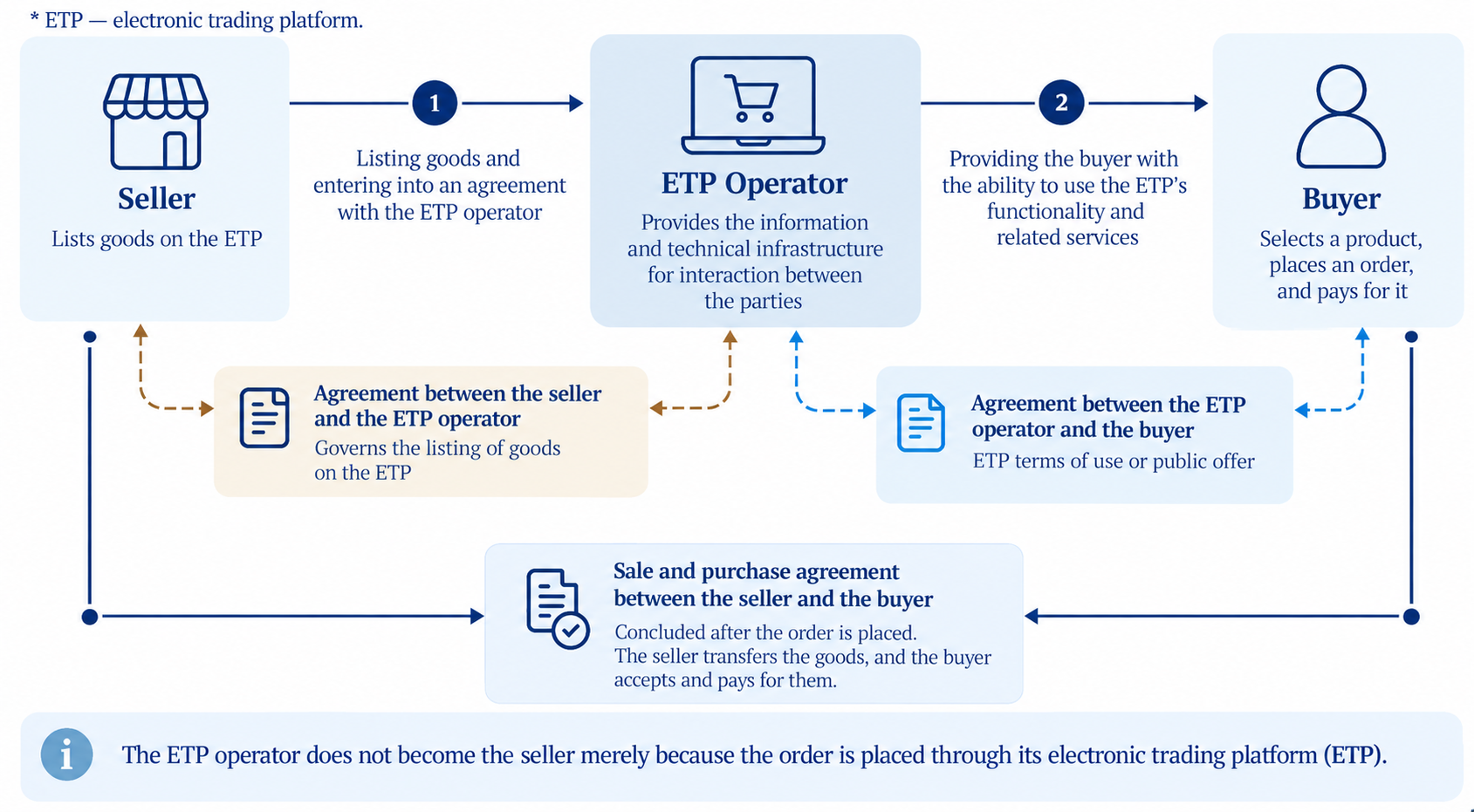
An ETP operator is engaged in organizing the electronic infrastructure for concluding a sales contract for goods or services between the seller and the buyer [Law «On Electronic Commerce» Article 12].
The seller lists the goods on the electronic trading platform of the ETP operator, and a separate contractual relationship is established between the seller and the operator, regulating the placement of goods on the platform.
Next, the buyer accesses the electronic trading platform, selects a product, and places an order. At this point, the ETP operator provides the information and technical infrastructure that allows the buyer and seller to interact and conclude an electronic contract, while the ETP operator itself does not become the seller merely because the order is placed through its platform.
After the order is placed, a sales contract is concluded between the buyer and the seller (the conclusion of this contract is discussed in detail in section 6). In this case, the seller is the party to the contract that undertakes to transfer the goods to the buyer, while the buyer undertakes to accept and pay for the goods. Therefore, the main contractual relationship concerning the goods themselves arises specifically between the buyer and the seller.
At the same time, the buyer may have contractual relationships with the ETP operator in connection with the use of the electronic trading platform, but these relationships are governed by the platform’s terms of use or the operator’s public offer, and their subject matter is providing the buyer with the opportunity to use the platform’s functionality and related services.
6. Procedure for concluding a sales contract in electronic commerce
Sales contracts concluded in electronic commerce must comply with the requirements of the Civil Code, and they are formalized by agreeing on the terms of the contract through the approval of electronic documents or electronic messages between the parties in the form of an electronic document [Law «On Electronic Commerce» Article 14].
In electronic commerce, an offer is formed in the form of an electronic document.
An offer in electronic commerce must contain [Law «On Electronic Commerce» Article 16]:
- the name of the person who sent the offer;
- the postal and email addresses and phone number of the person who sent the offer;
- in cases provided for by legislation, information about the availability of a license or a permit document (the number of the license or permit document, its validity period, and the name of the specially authorized body responsible for licensing certain types of activities or issuing the permit document);
- the procedure for concluding the contract, as well as the procedure for sending and withdrawing acceptance;
- the possibility and procedure for making changes and additions to the contract when agreeing on its terms;
- the terms of delivery and payment for goods, as well as the prices offered for them;
- references to the terms incorporated into the contract by reference to an electronic document published in a publicly accessible information resource.
An offer in electronic commerce may also contain other information in accordance with the legislation.
A contract may be concluded by means of acceptance [Law «On Electronic Commerce» Article 16]:
- In the form of an electronic document (providing for confirmation by an electronic digital signature);
- In the form of an electronic message (expressing the consent of a participant in electronic commerce);
- By performing actions to fulfill the conditions specified in the offer.
A contract is considered concluded from the moment the participant in electronic commerce who sent the offer receives acceptance of that offer.
Contracts for digital products distributed by downloading them via the internet are confirmed by:
- Receipts, payment confirmations for the acquisition of rights to a digital product, and other messages that make it possible to identify the parties to the contract, generated by information systems during distribution without the use of a physical medium;
- Internal documents of the business entity (reports of the responsible person of the business entity, bank statements, accounting certificates, and others).
Electronic documents in electronic commerce, as well as information recorded in electronic form that makes it possible to identify its sender, are equivalent to documents executed on paper and signed by hand and may be used as evidence of the conclusion of a contract.
In addition, when concluding contracts for which legislation or an agreement between the parties requires a document to be signed by hand, an electronic document is considered signed if the parties have confirmed the electronic contract with an electronic digital signature.
At the same time, electronic confirmation methods (such as SMS, Face ID, or others) that express consent and make it possible to identify and authenticate the person who signed the document are also recognized as signatures [Law «On Electronic Commerce» Article 14].
Conclusion
This memorandum examines the key aspects of the legal regulation of e-commerce in Uzbekistan. However, depending on the specific business model, additional legal requirements may apply.
This memorandum is for informational purposes only and does not replace legal advice.